Thursday, April 12, 2012

Hi, My Name is Satan 3: Beelzebub Edition

Hi, My Name is Satan Beelzebub. 

So here and here we looked at artists' representations of the devil, from Power Puff Girls to Hieronymus Bosch. But what about Beelzebub? He's sometimes conflated with Satan and sometimes his own character, and is also known as Lord of the Flies. You might know him from Queen as someone who plans ahead and delegates.

Heya.


Paradise Lost - John Milton

In Milton's Paradise Lost, Beelzebub is a high-ranking angel and Lucifer's bestie. The whole "war on Heaven" thing comes out of their late-night bitch session about Jesus, and after the Fall, Beelzebub is the de facto second-in-command in Hell. He's the perfect best friend character, too, setting up "but who could possibly be brave enough to venture into Chaos?" situations like a champ.

Lake of burning sulfur? Nothing these two bros can't handle.


The Sandman - Neil Gaiman

Poor Beelzebub. While Neil Gaiman goes with a suave Miltonic Lucifer in his Sandman series, he demotes the Lord of the Flies to a sniveling, literal interpretation. Like Hieronymus Bosch's Satan, Gaiman's Beelzebub is stripped of any vestige of allure or dignity, resigned to the sewers of existence.

He just needs a wig and some speech therapy.


Lord of the Flies - William Golding

If you went to middle school in the USA, you probably read Lord of the Flies, from which you learned that 1) British schoolboys are creepy as fuck, and 2) the totalitarian governments of Battle Royale and The Hunger Games could have skipped the whole "fight to the death or we'll kill you" thing and just thrown a bunch of kids on a beach with the same result. On this adultless island, humanity either fades away or is enhanced to its purest form, depending on how much of a misanthrope you are. Oh, you got a conch to symbolize order and civilized discourse? We raise you a severed pig head on a stake. Not scary enough? Just wait until you start hallucinating and the Lord of the Flies possesses it and talks to you. Humans: the real rotting monster.

AAAAHHHHAHHHHHHHHAHHHHHHHHHHHH!


Beelzebub - Ryuhei Tamura

Gonna be honest: I have never read this manga or watched this anime. But when my image searches for Paradise Lost illustrations of this character kept turning up not Dore or Blake artwork but a green-haired, clothes-adverse baby, I had to find out why this was. In this manga-turned-anime, a high school student discovers a baby - Beelzebub IV - who has been sent to Earth from Hell to destroy humanity. But first he has to grow up, and this lucky high school student is the one who gets to raise him! Hijinks ensue.


Images:
Engraving from 1678 edition of John Bunyan's The Pilgrim's Progress
Illustration by Gustave Dore for Paradise Lost 
Sandman panel from Comic Vine
Soul-killing still from Peter Brook's 1963 Lord of the Flies adaptation


Monday, April 9, 2012

Art & Revolution: Hunger Games


Adrienne Rich died last month, on March 27. In her poem "What Kind of Times Are These" she wrote, "this isn't a Russian poem, this is not somewhere else but here, / our country moving to its own truth and dread, / its own ways of making people disappear." The poem was written in 1995, years before secret overseas prisons and the NDAA entered the mainstream news.

I finally saw The Hunger Games this weekend. I read the book and enjoyed it, but seeing it onscreen somehow made all the parallels all the more eerie. The absurdity of the extreme wealth concentration in the Capitol. The ease with which narratives are controlled via the media. The calculated fear tactics of a repressive government. In one poignant scene, Haymitch, a broken, alcoholic winner of a past Hunger Games, watches in quiet anguish and anger as a parent buys their child a cheap plastic-wrapped plastic souvenir: a sword so he too can "play" Hunger Games.

In our world, you can buy Hunger Games nail polish. To be fair, the collection from China Glaze is called "Colours from the Capitol," suggesting that by wearing it, you too can be a Capitol citizen drowning in excess while watching less fortunate children fight to the death. 

After the rebellion, there was only smoke and ashes. And glitter.

But who am I to snark? Aren't I a Capitol citizen too, with my Foxconn-produced iPhone?

I wonder what author Suzanne Collins thinks. For her is it just a story? Did she hope readers would absorb something more? Does she, like Upton Sinclair upon seeing the reaction to his inhumane factory expose The Jungle, think, "I aimed at the public's heart, and by accident hit it in the stomach"? In his review of the film, Roger Ebert notes of Panem, the name Collins gives the book's country, "Mrs. Link, my high school Latin teacher, will be proud that I recall one of her daily phrases, 'panem et circenses,' which summarized the Roman formula for creating a docile population: Give them bread and circuses. A vision of present-day America is summoned up, its citizenry glutted with fast food and distracted by reality TV."

The Hunger Games juggernaut has become a circus critiquing a circus. But even with the nail polish, the made-in-China action figures, the millions reaped in merchandizing for corporations, The Hunger Games still has a feeling of rebellion in it. But does that lead to anything? Disney clearly had no reason to fear that after watching Wall-E, audiences would shun mass-produced, landfill-destined plastic Wall-E tsotchkes.

Brave New World, 1984, Fahrenheit 451. No free-thinking utopia sprung from these works, but they did give us more ways to talk about freedom and oppression.

Is it enough to be a scribe? To let others know, yes, I see it too? To let future generations know that not everyone agreed with the status quo? That that there was discontent and that a few tried to make it tangible in words? I don't have an answer right now, and this isn't supposed to be a complete exploration; I'm just rambling and wondering.

Maybe we are forever in T.S. Eliot's "The Waste Land" and forever both embracing and railing against it.

Tuesday, April 3, 2012

Bunnies for Easter

After last week's Easter eggs, my bunny-obsessed friend Betsy suggested a post on Easter bunnies. At first I wasn't convinced. Aren't bunnies a bit cloying and pedestrian? But as I searched my brain for bunnies in art, you could say I fell further down the rabbit hole. Or even that I...


Which brings us to one of the most famous rabbits: the White Rabbit from Lewis Carroll's Alice in Wonderland. As the impetus for Alice's journey, the White Rabbit has become a symbol for searching for purpose in life/waking to a new reality/drugs. Isn't that right, Jefferson Airplane? Helping the White Rabbit and so many other characters from the book reach icon status was John Tenniel, who did the illustrations in the original 1865 edition.

Grace Slick hopes that's a pipe.

But the White Rabbit isn't the only rabbit in Wonderland. There's also the crazed March Hare, who, along with the Mad Hatter and the Dormouse, is trapped in a perpetual absurdist teatime. 

If you ask Alice, she'll tell you these guys have the real drugs.

In 2010, a new edition of Alice in Wonderland was published by Harper Collins, lavishly illustrated by superstar artist Camille Rose Garcia. The nightmarish-but-beguiling tea party was a perfect fit for her style.

Told you they have the good stuff.

Mysterious white rabbits have also appeared in the work of contemporary artist Marc Burckhardt. Although delicate, his rabbits have a quietly lethal vibe, whether battling snakes or seeming to have traces of blood on their paws and mouths.

Burckhardt's "Mirror" on the cover of the Indiana Review.

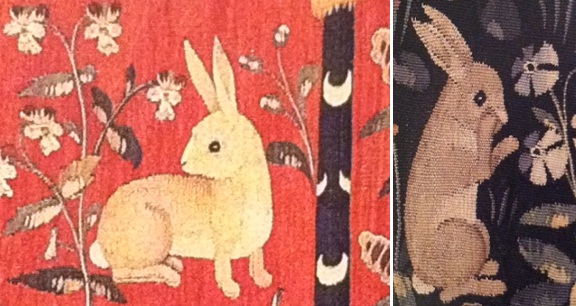
With their implied silence and keen observational eyes, his rabbits remind me of those in the backgrounds of the famed "Lady and the Unicorn" tapestries from late 15th Century Europe. 

Two of the many background bunnies.

Along with many other animals, the prolific rabbits watch the actions taken by the central figures of the lady, unicorn, maidservant, and lion. 

Alas, then there's how the Dutch do rabbits.

Melchior d'Hontecoeter, Still Life with Peacock, Rabbit, and Spaniel, c. 1660


Camille Rose Garcia illustration: PAPERMAG 
     -More of Garcia's Wonderland illustrations at Merry Karnowsky Gallery
"Lady and the Unicorn" tapestries: Cluny Museum.
d'Hontecoeter painting: image from PopArt Machine, owned by Legion of Honor