Showing posts with label san francisco. Show all posts

Friday, April 12, 2019

Dream Cast - The Maltese Falcon


With the remake trend showing no signs of stopping, I wouldn't be surprised if this one actually happens.

Some might call remaking The Maltese Falcon a sacrilege, but the 1941 classic film was actually the third onscreen adaptation of Dashiell Hammett's 1929/1930 novel. It was preceded by a 1931 version, which was apparently not great anyways, and - due to keeping the book's sexual and gay elements - censored after the Hays Code came into effect in 1934. Then in 1936, another version was released, but ended up differing so much from the source material that it was renamed Satan Met a Lady.

My dream version might not top the 1941 film, but hopefully would be more successful than the 1931 and 1936 attempts!

Previously in Dream Cast:
The Tempest
Frankenstein
Wuthering Heights
The Hunchback of Notre Dame


Sam Spade - Armie Hammer
He'd have to lose the beard, though.

In the opening paragraph of The Maltese Falcon, Dashiell Hammett writes of detective Sam Spade, "He looked rather pleasantly like a blond Satan." Somehow, I get Armie Hammer out of that. Sam Spade became a noir archetype: the always-cool, always-aloof detective who tells no one his plans or his emotions. Even though he's The Maltese Falcon's POV character, we don't really know how he feels about anything. Is he always 100% confident in himself? How does he really feel about his various love interests? There's a lot for Hammer to work with here besides a Bogart impression.


Brigid O'Shaughnessy - Amy Adams
Brigid knows blue dresses bring out her eyes.

I thought of several iconic redheads for this role (even though hair can obviously be dyed), including bubbly Emma Stone and elegant Jessica Chastain. Ultimately, though, it's Amy Adams's range and micro-expressions I'd love to see in the ultimate femme fatale. We're first introduced to her playing a damsel in distress named Wonderly, but even after she comes clean on that facade, we're never sure when she's playing a role or not. This part needs an actress who can play several layers of character, and we need to believe her every time. Adams it is!


Joel Cairo - Riz Ahmed
Get this man some flashy jewelry and an ascot.

Joel Cairo, a small, flamboyantly dressed "Levantine" man, doesn't come off as threatening. In fact, Hammett leans hard into mincing, effeminate gay stereotype. However, like Gutman, Cairo can be ice-cold when it comes to money. Played by Peter Lorre in the 1941 film, this scene shows why he shouldn't be underestimated. Versatile Shakespeare-and-Star-Wars Ahmed could rock this.


Caspar Gutman - Olivia Colman
Don't think she won't turn you into a Lobster.

Some might see this gender-bending pick and complain about feminism, but the 1936 film made this same switch, and look, Philip Seymour Hoffman is dead. Oscar-winning Colman would slay this role as a scheming, wealthy, globe-trotting crime boss determined to get the Maltese Falcon by any means necessary.


Wilmer Cook - Alex Wolff
Wilmer goes up against Sam a few times. None of them go well. 

Amateurish gunman Wilmer Cook is admittedly not great at tailing people undercover, but he's apparently pretty skilled under the covers. We learn that there was previously a rivalry between Cairo and Brigid for his affections (Cairo won), and this battle is briefly rehashed with a slap fight. Unfortunately for both Cairo and Brigid, a later scene suggests Wilmer actually has a the hots for Rhea, Gutman's daughter. Gutman, meanwhile, is like a surrogate parent to Wilmer, but is willing to negotiate on that.

Fun fact: Originally, Hammett had Spade refer to Wilmer as a "catamite," but his editor thought that was too explicit. So Hammett used "gunsel," a word that basically meant the same thing (a gay man's boy toy), but was more obscure. Since Wilmer is also a gunman, lots of readers took gunsel to mean that, and the meaning has morphed.


Effie Perine - Riley Rose Critchlow


Effie Perine is Spade's optimistic, competent Girl Friday secretary. The Maltese Falcon presents an extremely rose-colored-glasses version of workplace sexual harassment, where Spade calls Effie lots of pet names and rests his head against her for comfort, and everything is portrayed as consensual and harmlessly platonic. (I'd tone down the pawing for sure.) As a longtime administrative professional, I've got a soft spot for Effie.

Critchlow is both adorable and kickass as a wide-eyed cop in Crunchyroll's Anime Crimes Division (it's a little embarrassing to admit I watch Anime Crimes Division, which is...kind of the point of the show, which is very good), and I'd love to see her break out in film.


Iva Archer - Aubrey Plaza
Would you want to cross Aubrey Plaza?

Yeah, this is a small role for Aubrey Plaza, but she could have fun with it. Iva Archer is the wife (and quickly widow) of Miles Archer, Spade's doomed partner who is too boring and inconsequential to cast. Also, she and Spade have been having an affair. The Maltese Falcon is a roller coaster of a few days for Iva, who's kept in the dark regarding the central case. Her husband is murdered, and she thinks her lover, Spade, might have killed him in order to marry her. But then he freezes her out and she sees him with Brigid. Furious stalking on Iva's part commences. The novel ends with Spade finally about to meet her in his office to explain everything. (How that conversation goes is left up to the reader.)


Rhea Gutman - Anya Taylor-Joy


Rhea's role in The Maltese Falcon is the most confounding. She comes out of nowhere, and her part seems to be a red herring. However, her short scene - drugged, keeping herself awake by scratching her stomach with a pin, ostensibly trying to help Spade - is lurid enough to stick in one's imagination. What's her story? Whose side is she on? Maltese Falcon expert and super-fan Don Herron summarizes a few fan theories here, including one that attests she and Wilmer are actually one and the same! I personally don't think that's the case, and as such would cast different people in the roles. Anya Taylor-Joy, of The Witch and Thoroughbreds, would be beguiling in a cameo as Rhea. 


Image info:
Header image: 1941 movie poster
Armie Hammer: from Sorry to Bother You
Amy Adams: from American Hustle
Riz Ahmed: from IMDb
Olivia Colman: from The Lobster
Alex Wolff: from Hereditary 
Riley Rose Critchlow: from IMDb
Aubrey Plaza: from The Late Show with Stephen Colbert
Anya Taylor-Joy: from IMDb
Maltese Falcon statue prop: Wikimedia Commons

Saturday, December 29, 2018

Favorites of 2018 (and 2017)

L to R, top to bottom: Annihilation, Antony & Cleopatra,
Pelleas & Melisandre, Burning


Putting together "best of" lists in these times can feel frivolous, and last year I never got beyond a perfunctory list of my favorites. 2018 was a blur of more awfulness and protests, plus getting out the vote and progress in the Mueller investigation. It was also a damn fine year for cinema, and I got the list together. Here are my favorites in various categories (and 2017's picks at the end).


Movies
L to R, top to bottom: Blindspotting, Hereditary,
Burning, The Favourite, Annihilation,
The Death of Stalin


Annihilation: This movie reminded me of Under the Skin in several ways, including the audience's love-it-or-hate-it reaction. I loved it, but there was a lot of weird laughter at dramatic moments in my screening. Great special effects, and I preferred this contemplative, ambiguous film to director Alex Garland's debut, Ex Machina.

Blindspotting: With Black Panther, Sorry to Bother You, and Blindspotting, 2018 was a big cinematic year for Oakland. Directed by Carlos López Estrada and written by and starring Daveed Diggs and Rafael Casal, tonal roller coaster Blindspotting looks at a contemporary, gentrifying Oakland and police violence.

The Death of Stalin: I watched this movie twice this year. Once in theaters, and then again after Brett Kavanaugh was confirmed to the Supreme Court. Totalitarianism is a cancer, but the way its aggrandizement and increasingly ludicrous untruths inevitably paint its loyalists into corners is ripe for satire. How else to capture the whiplash of absurdities and atrocities?

Hereditary: As in other A24 horror movie The Witch, a teenager must deal with not only a malevolent supernatural entity, but with guilt, grief, and the weight of the family's blame in the aftermath of a tragedy. Toni Collette and Ann Dowd are powerhouses.

The Favourite: I went into this expecting to be wowed by Olivia Colman, and was even more wowed than anticipated. Yorgos Lanthimos takes a historic event (Britain's withdrawal from the War of the Spanish Succession) and gives us a tightly wound story of politics, power plays, chronic illness, abusive relationships, and Mad Max: Fury Road's Nux in elaborate 18th Century finery.

Burning: Based on a short story by Haruki Murakami, this slow burn by Chang-dong Lee is a master class in cinematography and tension. It's also very much of the zeitgeist. In Burning, Seoul's underemployed millennials live in cramped, dark studios or their parents' houses and compete in the marginal gig economy while their 1-percenter peers lounge in the tony Gangnam neighborhood Psy made world-famous a few years back. The three lead actors (Ah-in Yoo, Steven Yeun, and Jong-seo Jun) are excellent.


Books (I read in 2018, not necessarily published in 2018)


Moriarty by Anthony Horowitz: This twisty post-Reichenbach Falls Sherlock Holmes novel deals with whether or not math professor/crime lord James Moriarty survived that incident. Includes my new favorite Moriarty origin story. (Fans of this sort of thing might also want to check out Professor Moriarty: The Hound of the D'Urbervilles by Kim Newman.)

Wonder Valley by Ivy Pochoda: Drifters, runaways, and cultists populate this contemporary Southern California noir.

The Charm Buyers by Lillian Howan: One of the highlights of 2018 was reading at Lit Crawl, an annual evening of literary readings across San Francisco's Mission District. After my group's reading, a few of us ended up at a reading where Lillian Howan read a short story so powerful that I had to look her up and order her novel. In The Charm Buyers, Marc Antoine Chen, a member of the Chinese Hakka community in Tahiti, has a loving extended family and is the heir to a fortune in black pearl cultivation. But Marc seems determined not to make life easy for himself, shunning his father's business in favor of his own illegal operations and falling for first his cousin and then an older French woman. When his cousin falls ill, Marc must decide whether or not to potentially sacrifice everything for her.

The Yonahlosse Riding Camp for Girls by Anton DiSclafani: Just squeaking in under the wire (I devoured this book over the holidays) is this Depression-set page-turner about a Florida teenager sent away to a remote girls' boarding school after a mysterious, scandalizing incident. Horses + a narrator who's a prickly but engaging addition to the "coming of age" genre.


TV
The Good Place and Kid Gorgeous at Radio City


While the movies I loved this year often starkly confronted our current times, I looked for laughs and comfort in other media. This year I finally started watching (and quickly got caught up on) The Good Place, which, despite being about death and Hell, is a warm blanket and cup of tea of a show. Honestly, few things have helped me with my anxiety as much as William Jackson Harper's Chidi.

John Mulaney's special Kid Gorgeous at Radio City is his best so far and a welcome respite as we try to deal with the horse loose in this hospital. Plus, there's a solid intro of Art Deco porn if you're into that.


Theater
The dancers of Fury


Pelleas & Melisandre: I attended all three of West Edge Opera's summer productions, and this Debussy opera directed by Keturah Stickann was my favorite with its lush, sensuous sets and costumes. For 2019, I'm most looking forward to Elkhanah Pulitzer's take on The Threepenny Opera!

Fury: A ballet based on Mad Max: Fury Road? It works!

Antony & Cleopatra: A National Theatre Live production with Ralph Fiennes and Sophie Okonedo as Shakespeare's hot mess couple? Yes, please! I bought this ticket impulsively on a Bad News day (I don't even remember which one), but it was well worth the drive to the Lark Theater in Larkspur.


Other


Randy Rainbow: Another year of the Trump Administration, another year of Randy Rainbow keeping us sane! Throughout the lows and lower lows of 2018, Randy was there with timely song parodies. My personal favorite this year was his Gilbert and Sullivan take on "a very stable genius," but other topics included Rudy Giuliani joining Trump's legal team and the ever-intensifying Mueller investigation. Can't wait to see him live with my mom in 2019!


And 2017:

Theater:
SF Ballet Frankenstein
SF Ballet Salome
Cyrano de Bergerac - Livermore Shakespeare
La Traviata - SF Opera
Girls of the Golden West - SF Opera

Books:
Lincoln in the Bardo by George Saunders
A Brief History of Seven Killings by Marlon James
The Decameron by Boccaccio

Movies:
The Florida Project
Paterson
Call Me By Your Name


Saturday, September 15, 2018

Mad Max Fury Road: the Ballet

The Mad Max crew rushes back to the Citadel


On Friday, 9/14/18, I woke up with a headache. Then my cat threw up under the bed. I managed to get to work on time. There was an exciting development, with Manafort flipping, but what really jump-started my day? A tweet from San Francisco Ballet about a performance some of its dancers were in: a ballet inspired by Mad Max: Fury Road. I love ballet. I love Mad Max: Fury Road. There were only two performances: that night and Saturday night, which I wouldn't be able to make.

I have never bought a ticket so fast. Somewhere in the digital dash for a Fury ticket I absorbed that principal Frances Chung was one of the SF Ballet dancers, but it was only after I purchased my general admission ticket that I saw that two of my other favorites, Dores André and Jennifer Stahl-Weitz, were performing as well, along with Luke Ingham and three principals from Alonzo King LINES Ballet: Adji Cissoko, Babatunji, and Michael Montgomery. How had I not known about this before Friday? I followed both Frances Chung and Dores André on Instagram, but somehow despite my social media addiction, was not paying it enough attention.

My headache continued, impervious to meds or caffeine. But I was determined, and after work I hoped on the T, stopped for a quick pizza dinner in the Dogpatch neighborhood, and then continued to the Midway SF, an arts space in an industrial area near Islais Creek.


An abandoned something or other nearby

The crowd was definitely younger and hipper than most ballet crowds, but there were plenty of older folks willing to come out in the middle of nowhere to see such illustrious dancers. (Or maybe I'm prejudiced - the well dressed Boomers could have also been hardcore fans of George Miller's dieselpunk masterpiece with zero connections to ballet.)

The doors opened at 7pm (there was no indication of when the performance would start, and a last-minute Facebook query went unanswered). Inside the dark, maze-like complex was a stage-in-the-round connected by a catwalk to a stage for the musicians. There were multiple bars. There was an attached cafe with more alcohol and food. There was a VIP room. I came alone and I'm not cool, so instead of socializing and drinking, I got a water from the bar, plopped myself on the concrete floor in front of the stage (chairs and stadium seating were strictly for those who had bought VIP tickets), and used my phone's flashlight to read a novel I had with me. My extreme uncoolness ended up being a huge boon.


Babatunji (Max) and Montgomery (Nux) on the catwalk,
with the VIP crowd behind them

I sat there on the floor for over an hour (the show finally started around 8:45pm) as my headache continued and the room filled up. Based on a few social media posts I saw afterwards, a lot of people couldn't actually see the show. Apparently some tried standing on the bars, but were made to get down. Another person on twitter said many left. I was impervious to all this.

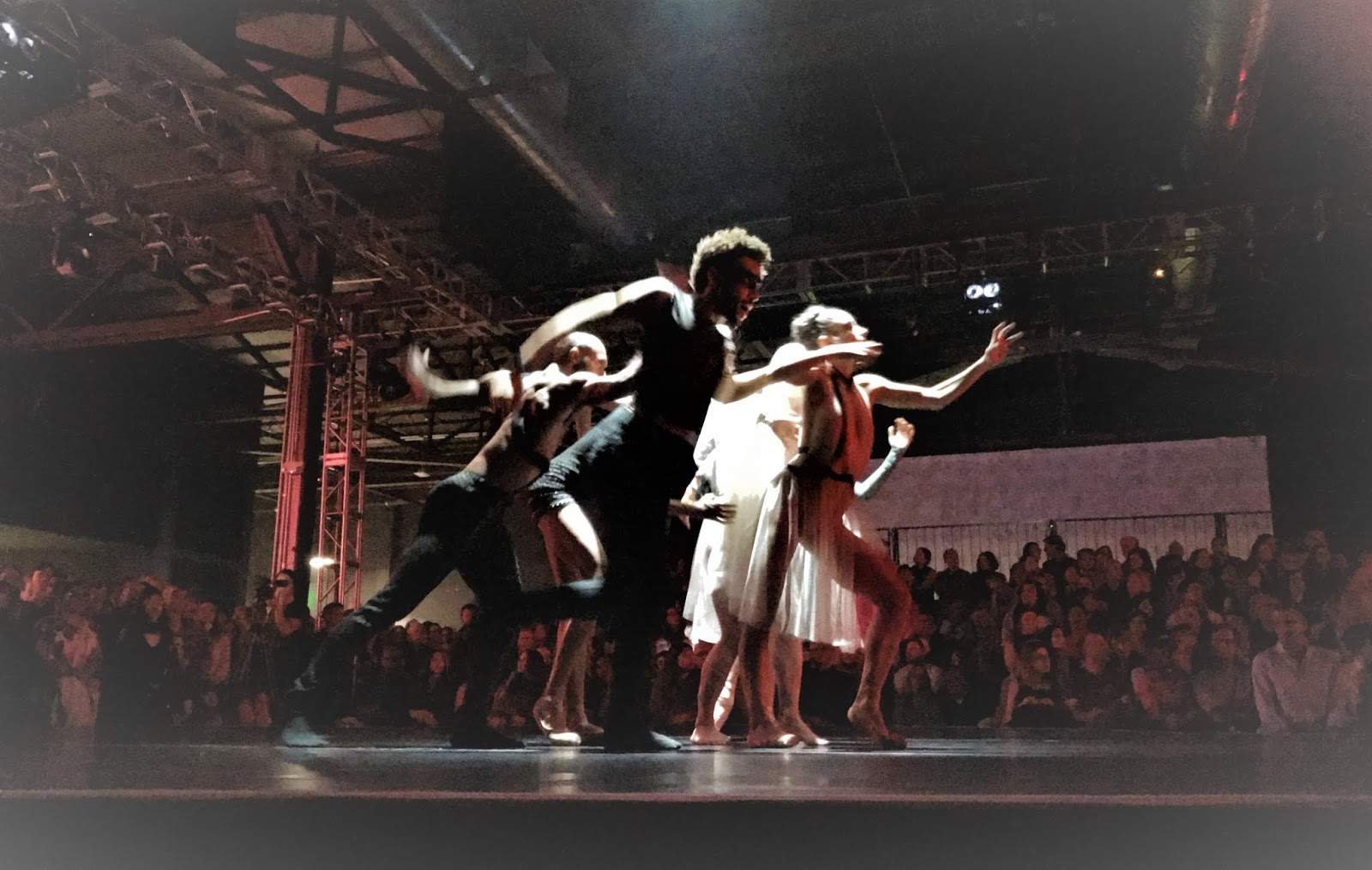
Just how amazing my spot was didn't completely dawn on me until the dancing started. The music was by classical/pop fusion band YASSOU, and it was original, not Junkie XL's (a.k.a. Tom Holkenborg) soundtrack from the movie. YASSOU front woman Lilie Hoy (who played Capable) opened Fury with a song about memories of the world before the apocalypse while the projection screens showed lush green landscapes. The music was good, but I'll be totally honest: I was there for the dancing, and found the opening song a bit slow.


Babatunji, Montgomery, and Hoy

But then Luke Ingham charged out! Playing a much hotter version of Immortan Joe (sadly, I did not get any passable photos of him), Ingham moved around the tiny round stage with power and abandon. At one point he rushed nearly to the edge of the stage where I sat, and I realized that I was 1) sitting within arm's reach to a performance by some of the country's best dancers, and 2) that I had paid $35 for it. Yeah, I was on a hard floor and had to hunch down a little to see under the barrier, but it was still a better view than the box seats at the War Memorial Opera House (I assume).

By the time Babatunji made the most interesting, graceful crawl across a pretend desert ever, the headache receded from my awareness.

This elation only intensified as Stahl-Weitz (Splendid) and André (Toast) came out. I first fell in love with André when she danced the lead in Arthur Pita's Salome in March 2017, which I saw from a discounted dress circle seat. Her intensity can be felt from the balcony, but from a few feet away? Electric!


Dores Andre and Jennifer Stahl-Weitz

Also electric was Adji Cissoko as Furiosa. Her role as a principal at LINES is apt, considering her, well, lines. She is a live power line. And seeing Chung's (the Keeper of the Seeds) expressive face so close? Priceless (but again, $35!!!). A section en pointe with André, Chung, and Cissoko was a highlight for me.


Chung and Cissoko, VIP section in background

Although the story of Mad Max: Fury Road is obviously pared down for Fury the hour-long ballet, it gets the emotions right. You have the story of a harsh world, constant violence, and a group of various foes who come together in trust, love, and friendship to fight against evil. Hoy and Montgomery were sweet as young lovers Capable and Nux, but Babatunji and Cissoko were especially intriguing as Max and Furiosa. Their chemistry, explored in a fascinating pas de deux, was spot-on, and the audience went wild when they teamed up to kill Immortan Joe. (By jamming Cissoko's steel-like pointed leg in his face. Death by pointe shoe: it's ballet.)


Stahl-Weitz, Cissoko, and Andre

Also exciting about the show was its creative team. While ballet is having a great moment with young choreographers, many of the most famous are men (Arthur Pita, Justin Peck, Liam Scarlett, etc). Fury's choreographer is Danielle Rowe, and the composer (Kristina Dutton) and producer (Kate Duhamel) are women as well.

My takeaway from the crowd around me was that those who were able to see it loved it, but it was a disappointment for many of  those who had bought general admission and were not either tall or early enough to snag a spot on the ground. However, there was a camera crew, and the San Francisco Dance Film Festival was being promoted, so maybe it will show up there someday?

There is one more show tonight (9/15/18), and it looks like there are some general admission tickets left as of this writing. Get there early!


The stage

Image info:
All photos: terrible, mine (photos on social media tagged with #FuryShow were encouraged)

Thursday, December 7, 2017

De-Whitewashing the Past, Illuminating the Present: Girls of the Golden West

Davóne Tines as Ned Peters and Julia Bullock as Dame Shirley


I went on a big Nixon in China bender awhile back. Actually, I'm still kind of on it. For a long time, Bluebeard's Castle was the recording always in my car's CD player, but currently it's Nixon in China, the 1987 opera by John Adams and Alice Goodman. So I was eagerly awaiting the world premiere of Adams's latest opera, this time with Peter Sellars as the librettist and director, at San Francisco Opera.

I originally had a ticket for last week (pro tip: if you're in the Bay Area, an opera fan, and under 40, BRAVO! CLUB is the way to go for cheaper tickets), but then my cat Eponine, the best cat in the world even though she is sometimes naughty, got sick with a flare-up of pancreatitis. With an intermission, the show's run time is over three hours. Since I'd be going directly after work, I knew there was no way I'd be able to give the opera my full attention while worrying about how my special girl was doing. Fortunately, I managed to change my ticket date, Eponine got better, and I was able to at last see Girls of the Golden West on Tuesday, 12/5.

Reviews have been mixed, and I will admit there are some glaring weaknesses. However, when I left the War Memorial Opera House, I was dazed and shaking. Despite flaws, I felt I had seen something truly important and of the zeitgeist.


The special girl in question


Those familiar with opera might be asking, "Wait. Isn't there an opera already with that same name?" Sort of, and that's part of the story. Some years ago, Peter Sellars was asked by La Scala to direct a production of Puccini's La Fanciulla del West, often translated as The Girl of the Golden West. But Sellars disliked the whitewashed, corny opera about the Gold Rush. Instead, he decided to produce, with longtime creative partner John Adams, a Gold Rush opera that told the reality: that the Northern California of the Gold Rush was beautiful and diverse, but rife with racism and sexism. Girls of the Golden West, particularly the second act, focuses on the spates of white supremacist violence that broke out and the lynching of Josefa Segovia on July 5, 1851.

The cast of Girls of the Golden West is young, diverse, and mostly American. Julia Bullock stars as recent East Coast transplant Dame Shirley, and Davóne Tines is Ned Peters, a former slave she befriends and possibly has an affair with. Paul Appleby is Joe Cannon, a 49er in a violent downward spiral. Ryan McKinny is his friend, Clarence. Hye Jung Lee (who played Madame Mao in SF Opera's production of Nixon in China) is Ah Sing, an ambitious Chinese victim of human trafficking who latches onto Joe in an attempt to better her life. J'Nai Bridges is the doomed Josefa Segovia, and Elliot Madore is her lover, Ramon.


Paul Appleby as Joe Cannon and J'Nai Bridges as Josefa Segovia


Like other Sellars/Adams operas, Girls of the Golden West uses various texts to tell its based-on-a-true story. The main material is the collection of letters Louise Clappe, better known as Dame Shirley, wrote while living near the mines with her doctor husband. Passages from Mark Twain, Shakespeare, journals, contemporary reporting, and folk songs are also worked in. Tines's aria based on a speech by Frederick Douglass is a high point, but this collage of sources is uneven (obviously a composition by Douglass, one of our nation's greatest speechwriters, is going to sound better than some random dude writing in his diary). Sellars isn't Goodman, who brought her own poetry to librettos.

That Sellars is working from this patchwork means that characterizations and relationships are limited by what he happened to find, relying on the performers and audience to fill in the rest. Bullock and Tines probably do the best with this. Their charisma and chemistry make you believe they are kindred spirits. They even pull off a scene where their characters start to fall for each other while pantomiming a rocky stagecoach ride - no easy feat.

The relationship between Ah Sing and Joe, on the other hand, is much harder to "get." Lee and Appleby also have chemistry, and the reason for their coupling is straightforward: Joe needs a rebound, and Ah Sing needs a meal ticket. Obviously that is going to turn into a hot mess. But when it does, something about the train wreck becomes inscrutable. Of the titular "Girls," Lee's Ah Sing is the least knowable, and we don't get a resolution for her. Joe's fixation on Josefa comes out of nowhere.


Hye Jung Lee as Ah Sing and Paul Appleby as Joe Cannon


But the faults here could be overlooked, at least for me, due to the sheer power of the second act. With a set, tight time frame (July 4th and 5th); a built-in structure (the July 4th holiday pageant and then a hasty trial); and rapidly rising racial resentment, the hour-and-a-half second act had me on the edge of my dress circle seat. It felt like an encapsulation of 2017.

Two scenes especially stand out in this regard. At one point, the angry mob of white miners come marching out with torches. At this point, I felt my stomach drop, and heard from the audience a noise mirroring that emotion - part gasp, part moan. The image, of course, immediately brought to mind the white supremacists bearing (tiki) torches as they marched in Charlottesville, Virginia in August this year. And those marchers, of course, were purposefully bringing to mind the many marches of white men bearing torches that came before them.

While media outlets have been criticized for focusing so intently on white supremacists rather than those they aim to terrify, Girls of the Golden West never lets the audience lose sight of the victims. As the white mob rants and riles each other up and commits off-stage atrocities, Josefa and Ramon remain onstage, huddled in their home, cycling through terror, anger, hope, and despair.

Another moment that feels especially relevant in 2017 happens after Josefa has fatally stabbed Joe, her attempted rapist. In the mock trial she is put through as a prelude to lynching, the men of the town rally around the idea that the sexual predator was actually a great guy and surround his victim, intimidating and threatening her, drowning out anything she might say with their chorus of platitudes.


Josefa's "trial"


Adams was well aware of the growing real-life parallels, as revealed in this New York Times profile with Michael Cooper:

It was particularly jarring, he said, to write the opera’s climax — in which a Mexican woman is lynched — against the backdrop of the 2016 presidential race. “I kept hearing ‘Lock her up!’ at those horrible rallies,” Mr. Adams said, recalling news footage of Trump supporters chanting for Hillary Clinton’s imprisonment being shown as he wrote choruses for his opera’s angry mob.

Girls of the Golden West is not a perfect opera, but it is a powerful one, and a stark reminder that there is nothing new about a diverse America and strong women, nothing new about white supremacy as a reaction to "economic anxiety," nothing new about sexism, and nothing new about imagining an America that wasn't there.

Girls of the Golden West runs through 12/10 at San Francisco Opera, and then moves to the Dallas Opera and Dutch National Opera.


Image info:
All Girls of the Golden West photos: San Francisco Opera & Cory Weaver
Special Girl Eponine: my own photo

Sunday, June 18, 2017

Leaving San Francisco, Keeping the Poems

China Beach


I knew it was going to happen eventually: getting priced out of San Francisco. For the past few years, the SF housing crisis and its astronomical rents have been international news, and I don't live in a rent-controlled unit. Friends and co-workers, especially those starting families, have left the city in droves to find slightly more affordable housing. Others have been subject to suspect "owner move-in" evictions. In 2015, quintessential San Franciscan cartoonist Paul Madonna was evicted from his Mission apartment and studio. When my roommate and I got notice that our rent (which has gone up annually for years) would be increasing by $600 a month, it was time to leave.

I'm not a lifelong SF resident. I moved to the city in January 2009 with my copy of Broke-Ass Stuart's Guide to Living Cheaply in San Francisco (I can't imagine what the most current edition recommends). However, I am a native of the San Francisco Bay Area, and I wonder if eventually I won't be able to afford to live within a three-hour radius of San Jose, the city where I was born.


I spent a lot of time on the 38 Geary


In the meantime, however, I've signed the lease for a tiny but lovely Oakland studio (where I'll be able to have a cat!), and look forward to exploring a new city. And I'm not completely leaving San Francisco - like scores of other East Bay residents, I'll be crossing the bay every weekday morning to the Financial District, where I work as an administrative assistant. But I will miss the Richmond District, the "uncool" but formerly affordable neighborhood I've inhabited in three different apartments since first arriving in the city.

This weekend I hauled two large bags of books to sell to Green Apple Books, the Inner Richmond landmark and my favorite bookstore in the world. Afterwards, I stopped by 6th Ave. Aquarium, the crowded, sketchy store where a shark for sale inspired my poem "Wobbygong Shark $299.99." While saying a mental goodbye to the area, I thought of how San Francisco, and especially the Richmond District, has shaped my writing. Perhaps because of "write what you know" and the city's own varieties of beauty and ugliness, San Francisco is the setting for two of my (unpublished) novels and various poems.


Sharks and stingrays for sale at 6th Ave. Aquarium


When I first moved to the city, the places I explored on the weekends were mostly tourist hotspots. One favorite place to go was North Beach. There, I would eat cannoli at Stella's and browse at City Lights Books. A disturbing incident there became my poem "City Lights, Dirty Window." Looking back, I think of how differently I would have handled the situation as an early-thirty-something instead of an early-twenty-something (of course, the creep probably knew better than to target someone who would break his nose). I can now see the statues mentioned from my office building, where they stand as a reminder that art and darkness exist side-by-side in this city.


Corona Heights Park


Long before I moved to the city, the Richmond District was important to me. It was a family tradition to meet my late maternal grandparents for lunch at Louis', the little clifftop diner overlooking Seal Rocks and the ruins of Sutro Baths. My mom shares memories of outings to the long-gone Playland-at-the-Beach, where now stands the Safeway I go to for seaside grocery shopping.

One thing I love about the Richmond District is this proximity to the ocean. I live close to China and Baker Beaches, but sometimes I also visit Ocean Beach, which is the western border of the Richmond and Sunset Districts (and San Francisco itself).  In February, I joined thousands at Ocean Beach for a protest of the Trump administration. I tried to capture the feeling of this popular - but still wild and dangerous - beach in my poem "Ocean Beach, Late November."


Ocean Beach (in July)


The Richmond District is also known for its fog. While a bane to some, the fog, known as Karl to many, is generally beloved. I love and will miss the way light halos through it. The often repeated experience of going to a movie at the 100+ years old 4 Star Theatre and then walking home through the fog led me to write "The 4 Star Theatre." When the poem was published, I was touched to get an email from someone who had used to live in the neighborhood and had recognized the little theater.

With the fog comes the foghorn. The plaintive, demanding sound can be difficult for new residents to sleep with, but you soon get used to it. My most distinct memory of the foghorn comes from September 2009. A few weeks earlier I had undergone a thyroidectomy at UCSF due to papillary thyroid carcinoma (a type of thyroid cancer). I was back at my then-apartment at Clement and 16th Avenue, and was looking in the mirror, getting ready to peel off the final bandage from my neck. The foghorn made for a spooky soundtrack as I slowly revealed my scar.


The 4 Star Theatre


I'll miss my neighborhood. I'll miss the fog, the foghorn, the cold beaches, the views of the Golden Gate Bridge and Sutro Tower. I'll miss walking to the Legion of Honor, one of my favorite museums. I'll miss my apartment's bay windows. I'll wonder about the future of the city, which at the moment only seems interested in welcoming those making six figures. But I'll always have my San Francisco writings, and for that, I am thankful.


Sutro Tower


All photos mine.

Sunday, February 19, 2017

Shelley Gets Her Due in Dance: Frankenstein the Ballet

A new version of Frankenstein's Creature

As someone who's been a little obsessive about Mary Shelley's Frankenstein, I was ecstatic when San Francisco Ballet announced last year that they would be staging Liam Scarlett's new ballet Frankenstein, which promo pics indicated would be close to the novel, in 2017. On Halloween, I scored a $45 orchestra ticket in a special sale and guarded it as if it held the secret to life. But in the final weeks before the North American premiere, I wasn't the only one shivering with antici...pation. I've never seen this much excitement about a ballet. Co-workers, my roommate's classmates, acquaintances on twitter: everyone wanted to see Frankenstein. I finally got to see the ballet on 2/18/17, and it did not disappoint.

The biggest draw for me was that unlike the many movie versions, Scarlett's ballet is deeply rooted in its source novel. The lack of an adaptation loyal to Shelley's work is why I ended up planning my dream cast, and this ballet is probably the closest fulfillment I'll get. There are no Igors; castle laboratories; or green, bolt-necked behemoths here. Instead, even with the changes needed for three acts of dance, we get Shelley's novel. We get the stories of Victor Frankenstein, a university student who messes up big time; of his loving family and friends, whom he loses; and of the tortured life he recklessly brings into the world.

Although its world premiere was less than a year ago, Frankenstein feels like an established classic. It's worth noting that Liam Scarlett is only 30. With young choreographers like him and Justin Peck, ballet's future looks bright.


Frances Chung as Elizabeth and Joseph Walsh as Victor

I looked at casting as soon as it was available, but I accidentally looked at the matinee, the casting for which were principals Aaron Robison as Victor, Dores Andre as Elizabeth, and Luke Ingham as the Creature. When I checked again before leaving on Saturday night, I realized my mistake, and saw the cast would be Max Cauthorn, Lauren Strongin, and Taras Domitro. "Who is Max Cauthorn?" I wondered. He's a corps member - and a young one at that, being just a few years out of San Francisco Ballet School. He's also the only non-principal in the role. Likewise, Lauren Strongin, a soloist, is the only non-principal Elizabeth. (Both are also Bay Area natives. High-five!)

While disappointed that I wouldn't get to see Dores Andre again after she was such a standout in Program 1, I looked forward to seeing Strongin and Cauthorn, who are possibly under consideration for promotion [update: Max Cauthorn was promoted to soloist on 3/13/17]. It's great to see home-grown former SF Ballet School students, like soloist Wei Wang, who was an apprentice the year before Cauthorn was, rise in the ranks. And (this is where I clarify that while a ballet fan, I am not a ballet expert) I really enjoyed Cauthorn's and Strongin's performances. They were lovely and youthful together, and their early effortlessness together made the emotional impact of Victor's later distraction and avoidance all the stronger.

Meanwhile Taras Domitro, in a scarred, nude bodysuit as the Creature, brought maturity and depth to his coltish, heartbreaking, menacing character. His pas de deux with Strongin, as his terrified would-be stepmother, and then with Cauthorn, as the immature father who regrets him, are both standouts. (Domitro isn't tall, but he's like 80% muscle, and Cauthorn seemed to have zero problems tossing him around like he was a willowy ballerina.)


From the original Royal Ballet production

Other things I loved:

-Henry Clerval! Although there was one huge Henry-related problem (see below), I was thrilled that happy, doomed puppy-dog Henry made the cut in this adaptation. Soloist Angelo Greco played Henry Saturday night, and brought lots of sweetness to the role.

-Justine Moritz! One element of Shelley's novel that Scarlett kept but altered was that Frankenstein family maid Justine Moritz's mother hates her. In the novel, Justine's mother is just part of her backstory, but in the ballet she's present as the housekeeper. Even though Victor and Elizabeth see Justine (soloist Julia Rowe) as a friend, Madame Moritz (soloist Jennifer Stahl) coldly and relentlessly keeps her daughter in her place as a servant.

Scarlett's reason for this subplot becomes clear at the end of Act II, when Madame Moritz's desperation, regret, and seconds-too-late arrival to Justine's execution add an absolute gut-punch. Characters danced by Stahl, who was promoted to soloist after her starring role in 2013's Rite of Spring, just have bad luck with executions.

-Music: composer Lowell Liebermann's music is sumptuous and intense.

-Anatomy Theatre scene: the anatomy lab dance, with a dizzying array of students, medical assistants, beakers, and body parts, is a visual delight with lots of great little details (the lechery of soloist James Sofranko's professor, an assistant's curiosity, Henry's queasiness).

-Talented kids: there are a few SF Ballet School students in this production, but the child dancer with the most time on stage last night was Jonathan Yee as Victor's little brother William. It's a demanding role for a kid, with lots of acting, a duet with the Creature, and a fair amount of time playing dead, and little Jonathan did great. Good job, Jonathan!


I've got some things to say about this

Things I didn't love:

-Here is the biggest problem the ballet had: Henry Clerval's costuming. The opening scenes establish Victor as wearing a red coat. He wears a red coat in childhood. He wears a red coat as a teenager. So when Act I, scene 3 starts at the university, and we see a guy with Victor's same wig wearing a red coat, it's obviously Victor, right? Wrong! It's Henry. When Victor arrives with his red notebook, everything becomes clear, but I was confused at first, and from what I overheard at intermission, a lot of people were.

Then in Act II, Henry is wearing a green coat. I will admit to owning more than one color of coat, but I'm not in a ballet where people in the balcony need to quickly recognize me. Since other characters' clothes stay similar throughout, why not just have him wear a green coat in Act I so we can easily distinguish him from Victor and the other neutral-wearing students? But the worst is yet to come. In Act III, he's wearing another, different red coat. You're killing me, costume designer John Macfarlane!

-Henry and Victor: also, I wish Victor and Henry's friendship had been better established in Act I. I feel that would have been a better use of scene 4, rather than the "college students gonna college student" episode in the tavern. Scarlett has Victor and Henry meet as freshmen rather than as children, but they barely interact before Victor's breakdown lands him back at home, at which point Henry is living with them and practically part of the family.


Liam Scarlett featurette with the Royal Ballet
SF Ballet's Vitor Luiz on dancing the Creature

Frankenstein continues at San Francisco Ballet through 2/26/17.

Image info:
Header: Erik Tomasson and AKA
Chung and Walsh: Erik Tomasson
Royal Ballet: Bill Cooper
Corps member Esteban Hernandez in that damn Act III coat: Erik Tomasson
Programs and tickets: my own crappy photo

Tuesday, December 29, 2015

Favorites of 2015

Clockwise from top right: Mad Max: Fury Road, South Park, Pericles,
Mr. Burns, Gotham, and Bluebeard's Castle


Not a comprehensive best-of list; just my personal favorites from all sorts of media in 2015.

Books

The sun comes out after a good book.

Billie by Anna Gavalda: It rained all the first day of a family vacation, but I didn't mind, because I'd brought this book. This little gem of a novel (translated from the French) chronicles the relationship between two childhood friends determined to break away from their white-trashy town and make it in Paris. The two stick together through classroom awkwardness, homophobic violence, and a potentially fatal hiking accident - the immediate aftermath of which finds Billie telling their story to a star. Gavalda's skill shines in her use of Billie, an inarticulate girl who's bold but lacking in confidence, as narrator. Like Colorless Tsukuru Tazaki and His Years of Pilgrimage by Haruki Murakami last year, this was just the right book at the right time for me.

Horse Medicine by Doug Anderson: I'm a sucker for dead horse poems. Although that's what first drew me to this book, the collection encompasses Anderson's reflections on not just horses, but religion, war, and aging. My favorite lines come from "What the Angel Said": "Who are you to think/ you will not have to/ live history/ out all the way/ to the consequences/ and beyond?"

Paper-Doll Fetus by Cynthia Marie Hoffman: In this poetry collection, a rock falls in love with a goat placenta, and it makes sense. With fearlessness and compassion, Hoffman dives into the female reproductive system, exploring miscarriages, stillbirths, phantom pregnancies, and the traumas and joys of childbirth. There are poems told not only from the point of view of the aforementioned rock and the titular doomed fetus, but from a strap used to inhumanely restrain laboring women and a lamb who dies shortly after being born. Periods still suck, but I appreciate them a little bit more having read this book.

The Good, the Bad, and the Furry by Tom Cox: Yes, Cox writes cat books about a famous twitter handle, @MYSADCAT, but his books transcend cat books and twitter books. They're thoughtful and funny reflections of the English countryside, parents, nature, music, and yes, cats.


Favorite Old Books I Read or Re-read


King John's Prince Arthur and Hubert in Laslett John Pott's engraving.

Dangerous Liaisons/Les liaisons dangereuses by Choderlos de Laclos: I finally read this French epistolary novel, and despite this being a cliche...yes, something written in 1782 can still be scandalous in 2015. Bored aristocrats the Marquise de Merteuil (a wealthy widow) and her best friend and former lover the Vicomte de Valmont (a bachelor and libertine) manipulate others sexually for fun and revenge. But what starts as a quotidian (for them) ruining of others' lives slowly turns into a battle of wills. Of particular interest are Merteuil's ruminations on the strict gender roles of the time and how she's gotten around them.

Wuthering Heights by Emily Brontë: I do a lot of my reading on the bus, and re-reading for the first time since high school this epic about an extended family who needs to get the mix of incest just right in order to heal always made me sad to reach my stop. It's too bad E. Brontë gets accused of romanticizing bad male behavior, because that's not really what's happening. Heathcliff and Cathy are weirdos who need to do their Heathcliff and Cathy thing, not a template for all heterosexual relationships. After reading, I watched three different adaptations (what Wuthering Heights really needs is a mini series that shows all generations at the correct ages) and listened to Kate Bush's song about the novel about a million times.

 King John by Shakespeare: I read this lesser known drama as just another stop on my way to reading all of Shakespeare's plays, for better or worse...but I really liked it and don't see why it isn't performed more. It's basically a less powerful Richard III, but I can see how it would be entertaining on stage. It has a central character audiences are somewhat familiar with (John is the mama's boy lion in Disney's animated Robin Hood), a great comic relief character in Richard the Lionheart's bastard son, a crazy mom meltdown, and a kid talking his way out of a hot poker to the eyes. How is this not a hit?


Movies

Patricia Velasquez leads Liz in September's cast.

Mad Max: Fury Road: This thrilling action movie had style, substance, and heart.

Liz in September: This beautiful tearjerker from Venezuela is the country's first lesbian romance movie.

Tom at the Farm: This tense, arty Quebecois rural noir finally got a limited run in the US.

Cartel Land: The drug cartels of Mexico have been a subject of fascination and horror for years. While 2015 saw fictional characters in Sicario tackle the US's involvement in the violence, Matthew Heineman went on the ground in this documentary about local efforts to quell the reign of terror. The film is an absolute gut-punch, although not in the way you'd necessarily expect: one grassroots group of courageous locals starts out as the lovable underdogs peacefully standing up to the cartels; later, Heineman pans his camera around the now-powerful group's new headquarters as individuals they've detained wait to be tortured. It's a crushing statement on moral corruption and the complexity of fighting evil.

One disputed artistic decision Heineman made was to include scenes of a self-appointed anti-cartel group in the US - basically gun aficionados in camo parading consequence-free around the border. Some critics felt like Heineman was giving this group legitimacy and supporting their cause, but I read the inclusion as ironic. The American group's belief that they're brave soldiers fighting a battle is shown to be a delusion of grandeur when juxtaposed with the citizens of Mexico who are actually dealing with the deadly reality of the cartels.


Theater

Nadine Sierra and Brian Mulligan in Lucia di Lammermoor.

Mr. Burns: A Post-Electric Play - A.C.T.: Anne Washburn's Simpsons-inspired meditation on storytelling and human resolve is one of the most polarizing plays I've seen. Full write-up here.

Swimmer - San Francisco Ballet: Yuri Possokhov, SF Ballet's choreographer in residence, based this ballet on a John Cheever short story. The loose plot is that a philandering businessman swims through neighbors' pools, glimpsing others' lives. But when he returns to his own suburban home, he finds his nuclear family is gone. The piece is a celebration and examination of the American mid-century modern aesthetic, and is visually stunning. However, while the video projections sometimes added a lot, they weren't always necessary (example: in the final scene, it was clear from the dancer's pantomime that he was flailing in the water; the added video footage of a man flailing in water was superfluous).

Pericles - Oregon Shakespeare Festival: I'm so glad I got a second chance to see the play that made Pericles good!

Lucia di Lammermoor - San Francisco Opera: I was lucky to share in a friend's complimentary tickets to this opera with rising star Nadine Sierra (excellent as Musetta in last year's La Boheme at SF Opera). The set for Enrico's office was breathtaking and properly imposing, and the famous "mad scene" was especially visceral.

Other theater favorites this year: Dan Clegg unexpectly stole the show as Edmund in California Shakespeare Theatre's King Lear; Berkeley Rep scored one of the top Eponines, Samantha Barks, for Amelie; and I finally got to see The Book of Mormon!


TV

Mikhail Petrenko and Nadja Michael in Bluebeard's Castle

Great Performances at the Met: Bluebeard's Castle: I caught the second part of this PBS double feature by chance. I turned on the TV, intending to veg out to the hot twins show on HGTV or something else other than a two-person Hungarian opera, but the channel was set to PBS, and the very first frame arrested me. By the end of the day, I had watched several other versions of the opera on YouTube* and added the music to my iPod.

At its most literal, Bluebeard's Castle (by Béla Bartók and Béla Balázs) is about a woman gradually realizing, and finally admitting out loud, that her new husband is a serial killer. But it's also about what we keep hidden within ourselves and the competing desires to deny or investigate in the face of unpleasantness. Mikhail Petrenko's and Nadja Michael's performances; the Met's minimalist yet dramatic staging in black, gray, white, blue, and red; and the skillful cinematography of this stage performance make for an hour that is almost unbearably tense, but too captivating to turn from. 

*Sadly, it looks like there's no DVD of the Met's production available yet. Other productions available on YouTube include Michael Powell's 1963 moviethis modern, noirish version; and the UC Davis Symphony Orchestra's performance (in English).

Unbreakable Kimmy Schmidt: Kimmy Schmidt joined the heroines of Mad Max: Fury Road and Room by also escaping her Bluebeard in 2015. While Fury Road told the tale as an action movie and Room used stark realism, Unbreakable Kimmy Schmidt did a risky take - humor - and succeeded.

Better Call Saul: The prequel is off to a good start with this concise first season. While it shares characters and the gorgeous New Mexico setting with Breaking Bad, Better Call Saul is developing its own brand of dark humor and character drama, and has its own breakout stars in Rhea Seehorn and Michael Mando. A highlight of the season was finally learning what happened with ex-cop Mike in Philadelphia in an episode that ended with a bravura monologue by Jonathan Banks. I'm hoping a future season will reveal the similarly hinted at dark past in Chile of Giancarlo Esposito's Gus.

South Park: South Park continues its high note as it nears drinking age. The satire in season nineteen was topical and withering without over-the-top seething. Targets included both politically correct ideology and reactionary conservatism, online advertising, gentrification (most notably in a stomach-churningly accurate condo commerical), and America's gun lust. And there was a nice break from the heaviness of real-world problems in a meta episode acknowledging one of the curiosities of the fandom: certain fans' obsession with the imagined romance between minor characters Tweek and Craig. The hilarious episode included musical montages set to fanart submitted by viewers.

Gotham: The pre-Batman Batman show hit its stride in the second season, leading with stellar performances by Cameron Monaghan (I will be so mad if Jerome's not in Indian Hill!), James Frain, Erin Richards, and the rest of  the regular cast. The intertwining of Gotham society's underbelly became more insidious than ever: Jim Gordon's relationship with Penguin's criminal enterprise became even deeper steeped in blood, Ed (the future Riddler) and Penguin became murder-buddies and roommates, and Wayne Enterprises was revealed to be working with Arkham Asylum on a series of inhumane medical experiments.

Besides the Jerome thing, my main complaints are the premature end of Sarah Essen and the unremarked upon absence of Renee Montoya. I hope Montoya's back in the second half of season two, which will feature the great BD Wong as Hugo Strange.


Art

A Robert Dighton work from Luminous Worlds

Janet Delaney: South of Market at the de Young: SOMA is probably the best example of San Francisco's gentrification and housing bubble, so 2015 was the perfect year to look at Delaney's photos of the neighborhood as it was in the 70s and 80s.

Luminous Worlds: British Works on Paper at the Legion of Honor: Tucked away in one of the farthest corners of my favorite museum, this exhibition of physically delicate works by Turner, Beardsley, Blake, and more was truly luminous.

Time|less: Kappy Wells, The San Francisco Gallery: Working with sheetrock and charcoal, Wells captured the magnificence of the glaciers we are losing to global warming.